The Panel
The Jungfernhof Concentration Camp Memorial Project: Reclaiming a Lost History
In November and December 1941, nearly 4,000 German and Austrian Jews — entire families — were deported by the Nazi government from their homes in their native countries to occupied Latvia. The name of each one of them is known from the deportation train rosters. Taken to an abandoned manor home at the Jungfernhof site near Riga, these people died of exposure to the elements by the hundreds, after which thousands more were shot by the German Nazis and their Latvian accomplices, with the remnants used for slave labor. 149 of the people survived the Holocaust.
Since 2019, the Locker of Memory Project led by Karen Frostig has sought to recover the history of this unremembered concentration camp. The 2024 discovery of the buried remains of the barracks building has set the stage for the project to move into a new phase: commemoration. Members of the Locker of Memory Project explain the origin and purpose of the project, relate the history the project has uncovered, and discuss ongoing efforts to place a memorial at the site.
Speakers:
Founding Director Locker of Memory Project, memorial artist, and descendant of victims, Dr. Karen Frostig, Professor, Lesley University, Cambridge, and Scholar, Hadassah Brandeis Institute at Brandeis University, Waltham, MA
The project’s lead historian, American Latvian, Dr. Richards Plavnieks, Associate Professor, Florida Southern College, Lakeland, FL
The Holocaust archaeologist who located proof of the camp’s existence, Dr. Philip Reeder, Professor, Department of Civil and Environmental Engineering and Science, School of Science and Engineering, Duquesne University, Pittsburgh, PA
The Latvian Jewish community leader, Ilya Lensky, Director, Museum “Jews in Latvia,” Riga, Latvia, and Latvian delegate to the International Holocaust Remembrance Alliance (IHRA)
Moderated by, Paula S. Apsell, Senior Executive Producer Emerita, NOVA; CEO, Leading Edge Productions; and Executive Producer and Co-Director of the feature documentary Resistance – They Fought Back
The Workshop
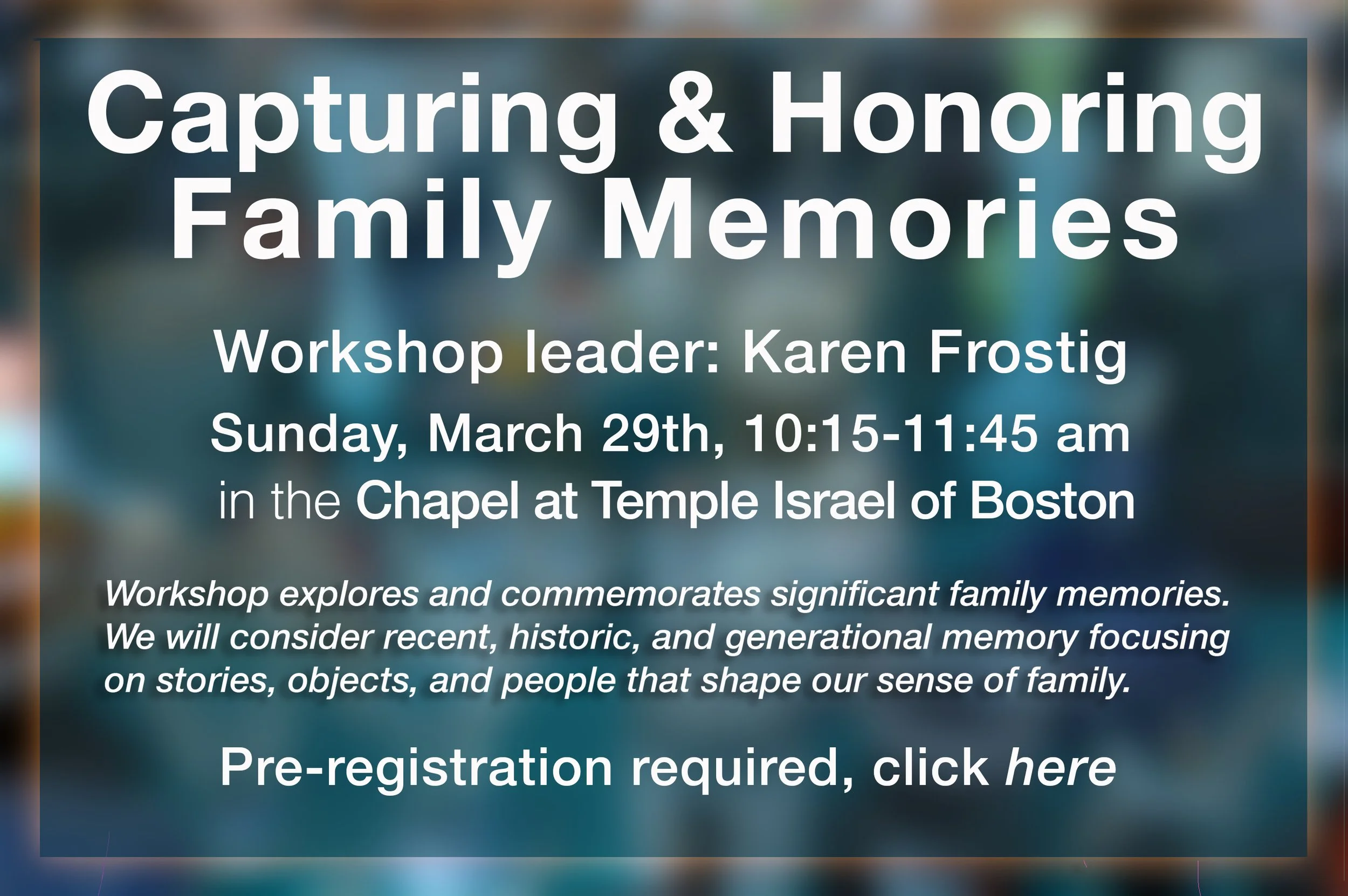
This workshop, led by Karen Frostig, is designed to help you explore and commemorate significant family memories. It focuses on the stories, objects, and people that shape your sense of family, from celebrations and traditions to losses and ruptures.
Preparation: Please bring a journal for writing and an object or photo of an object that stirs feelings about home and family: a special person, an ancestor you never met, a significant place, an occasion; a cherished object, a letter or jewelry; keys to your home, a photo of a special chair or a place that provides space for reflection, a garden, a book.
Discussion: The session starts by exploring the meaning of rituals and commemoration. The leader will share her own artistic process for creating meaningful objects, large and small, public and personal, related to her family’s history.
Writing & Creating: You’ll use a journal and a series of prompts to reflect on your own family memories and the object or photo you brought. The goal is to imagine and create a ritual to honor a specific memory. Paper and colored pencils will be provided if you wish to sketch your ideas.
Reflection: You’ll have time to share your experience with the group, discussing your original object, the process of creating a ritual, or the power of commemoration as a personal expression of meaning and memory.