Jungfernhof Concentration Camp
Riga, Latvia

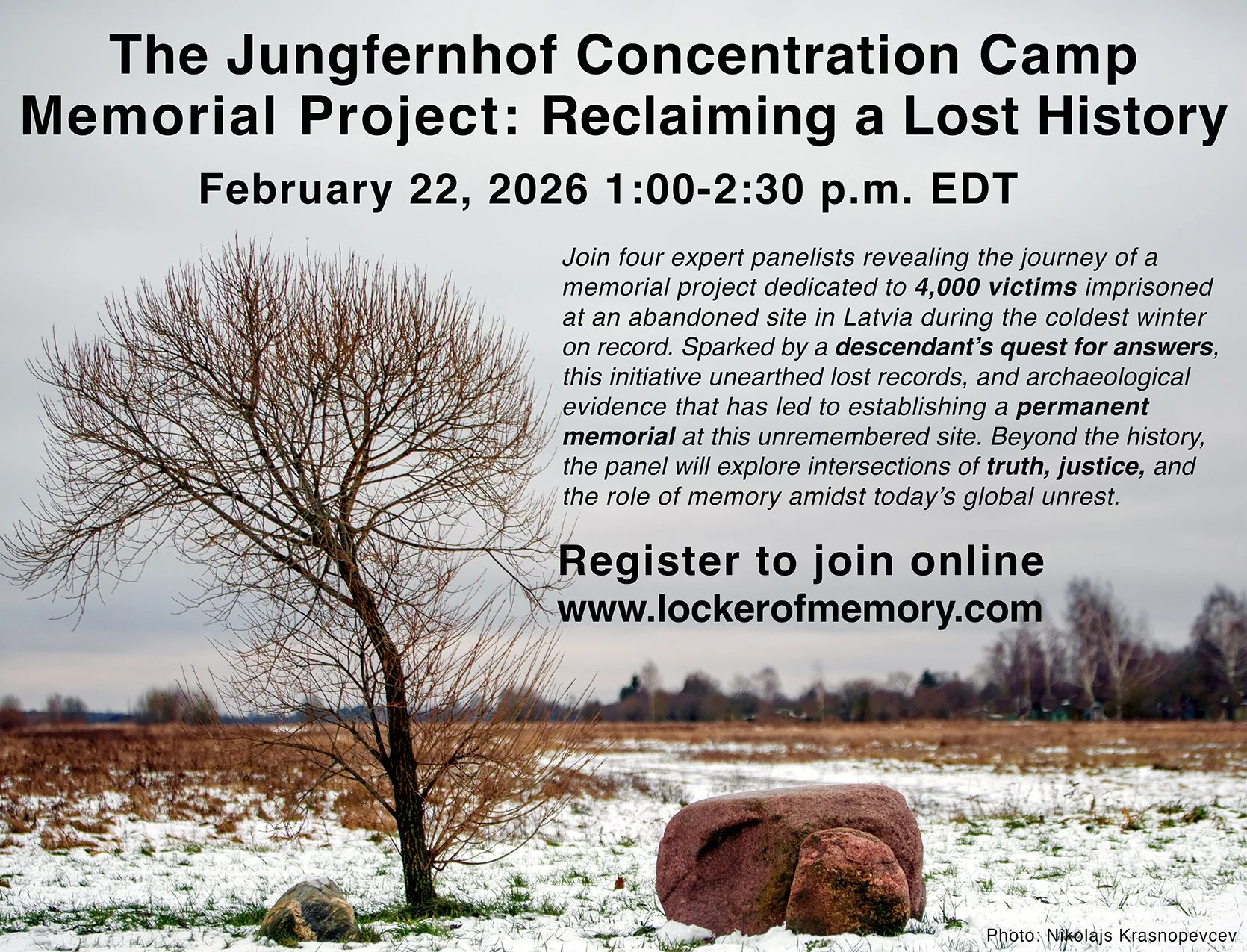
Speakers
Memorial Artist, Founding Director Locker of Memory Project, and descendant of victims
Dr. Karen Frostig, Professor, Lesley University, Cambridge, and Scholar, Hadassah Brandeis Institute at Brandeis University, Waltham, MA
The project's lead historian, American Latvian
Dr. Richards Plavnieks, Assoc. Professor, Florida Southern College, Lakeland, FL
The Holocaust archaeologist who located proof of the camp's existence
Dr. Philip Reeder, Professsor, Department of Civil and Environmental Engineering and Science, School of Science and Engineering, Duquesne University, Pittsburgh, PA
The Latvian Jewish community leader
Ilya Lensky, Director, Museum "Jews in Latvia," Riga, Latvia and Latvian delegate to the International Holocaust Remembrance Alliance (IHRA).
Moderated by
Paula S. Apsell, Senior Executive Producer Emerita NOVA, the CEO Leading Edge Productions and the Executive Producer and Co-Director of a feature documentary about Jewish resistance during the Holocaust entitled Resistance – They Fought Back
The Jungfernhof memorial will stand as testimony to nearly 4,000 lives interrupted by torture and murder. Yet, as we confront the legacies of slave labor and eighty years of willful forgetting, can a single monument truly hold the weight of such a complex history? The challenge is not only architectural but political and moral: Will the three nations responsible for these crimes finally share the cost of a permanent memorial, situated within a sprawling recreational park—a site currently devoid of honest signage? Furthermore, how will descendants and the public rise to meet this moment? In a year shadowed by lawlessness, mass deportations and ongoing wars, "caring" must transcend sentiment. We must ask what it means to honor the past amidst ongoing destruction, and how the artistry of memorialization becomes an act of profound courage.
Hitler’s plan to murder Europe’s Jews began in 1941. Deportations from Nazi Germany and the territory of Austria to the Jungfernhof concentration camp represent the first deportations to Riga and were among the earliest deportations to the East. Holocaust denial is prevalent all over the world. The Locker of Memory project is committed to speaking the truth about the past.
There is no expiration date on the memory of human atrocities. Memory after genocide is a collective action, an ongoing commitment to embrace truth and justice in opposition to hate and lawlessness. The Locker of Memory project is dedicated to remembering the victims and survivors of the Jungfernhof concentration camp. The first Nazi concentration camp built in Latvia under German occupation, the camp remains a neglected killing site abandoned for close to eighty years.
We now live in an era where science has produced new, non-invasive tools that allow us to see what is buried under the earth’s crust. Evidence is retrievable. Burying history is no longer an option. Forgetting the past is equivalent to placing a small bandage on a festering wound.

Six interviews with historians, descendants and survivors of the Jungfernhof concentration camp about “memory.” The tape was developed in April 2022, when Ukraine was under siege by Russia. Produced by the Locker of Memory project, dedicated to the preserving the history and memory of the Jungfernhof concentration camp where 3985 Reich Jews were deported and murdered between 1941-1944. Only 149 persons survived.
All records pertaining to the Jungernhof camp have been destroyed. Moving between multiple testimonies gathered from three living survivors, rigorous archival research conducted by four esteemed historians, and the recovery of scientific data obtained by world-renowned geospatial scientists using dramatic advances in ground penetrating radar technologies, we are slowly reconstituting the history of this unremembered site.
Memory is elusive, appearing and disappearing on its own accord. Truth is another matter. In today’s world, truth is highly contested, sometimes containing divergent and even opposing perspectives. Some argue, we live in a “post-truth” era, giving rise to Holocaust distortion, denial, and revisionism, complicating how we read the historic record. In this light, rescuing the evidence becomes central to our work. Committed to recovering the history and memory of the Jungfernhof concentration camp, the work serves as a precursor for creating a lasting memorial at this forgotten site.
People who attempt to find the Jungfernhof concentration camp are never sure of its precise location. Signage becomes the most basic and perfunctory means to identify a physical location. However, signage never tells the full story. It lacks the meaning and commitment that a memorial requires of its makers.
Memory following genocide begins with names, reclaiming the victims’ lived identities as a means of restoring human dignity to each individual. A memorial at Mazjumpravmuiža provides Latvia, Germany, and Austria with a new opportunity to reflect on their shared histories. As global citizens of the 21st century we ask, what have we learned about genocide and its aftermath that we want to impart to the next generation?
What might a meeting ground look like between a scenic public park and the presence of one or more recovered mass graves? How do we speak about the past in a world where justice remains more of a goal than a reality? What symbols and icons can be used to open up a fresh dialogue, eighty years after these atrocities took place? Can we come together and do this work with a full heart? This is how memorials serve communities.
Latvia is a country located on the Baltic Sea, situated between Lithuania and Estonia. Riga is Latvia’s capital city, home to 614,000 inhabitants.

To this day, the KZ Jungfernhof concentration camp in the Mazjumpravas muiža neighborhood lacks coherent boundaries or definition of place. This map helps orient visitors to the site.

Sunset at Mazjumpramuizha (2022). Photo credit: Nikolajs Krasnopevcevs
The camp had no fence. Chosen partially for its remoteness, there was no danger of escape. Armed guards secured the borders 24/7. Today this unremembered killing site remains invisible, overshadowed by a renovated landscape of the district’s new public park. Dedicated to relaxation and leisure the photo captures the contrasting histories of this complicated setting, containing a modest fountain, illuminated with festive lights changing colors into the night.
A complete listing of names, birth dates, and last addresses taken from Nazi documents listing all the deportees sent from Nuremberg, Stuttgart, Vienna and Hamburg to the Jungfernhof concentration camp can be found under the “About” tab on the navigational bar.
If you are a family descendant of victim(s) deported to the Jungfernhof concentration camp, an historian, archivist, educator, artist, writer, student, member of the foreign ministry in Germany, Austria, or Latvia, organizational leader dealing with Holocaust history and would like to join the mailing list or receive newsletters about this project, please get in touch using the contact section of the website.
